Published by:
CGP EDU Academic Team
Published on: August 13, 2026
Complete hydrolysis of  and
and  gives its oxides
  and
and  , respectively. Identify
  and
and  .
.
P | |
(a) | |
(b) | |
(c) | |
(d) |


Text Solution
Verified by ExpertsThe correct answer is:
C
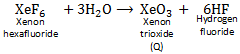
The complete hydrolysis of  and
and  produces
  which is xenon trioxide. This xenon trioxide is highly explosive and acts as a powerful oxidising agent in solution.
Complete hydrolysis of 

 on partial hydrolysis produces
  (xenon oxyfluoride).
Complete hydrolysis of 
Prepare Smarter with CGP Edu
Get practice questions, solutions, and test series in one place.
Write a Review
Share your experience with this question and solution.
Commentary
Send your comment, doubt, correction, or feedback to admin.
Similar Questions
Explore conceptually related problems
Relative stability orders of oxidation states of , In, are respectively
The standard electrode potential (in ) values for / are respectively
In the below reaction, geometry of respectively are
Statement I: Boron does not exhibit allotropy Statement II: Boron is extremely hard and black colo…
Which of the following statements are not correct? i. Atomic radius of is less than that of ii.…
The correct order of melting points of , In is